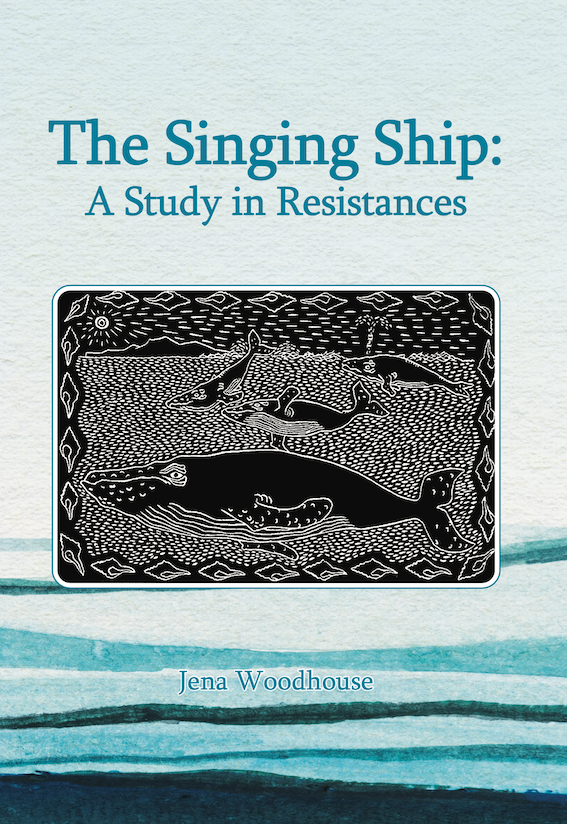
The Singing Ship
Jena Woodhouse
“Woodhouse finds a place among such poets as Judith Wright
and Mary Oliver, renowned for immortalising earth, nature
and species in their poems.”
Angela Costi, Rochford Street Review
“Woodhouse values learning, the past, other cultures, but is also
acutely aware of simplicities and their multiple potentialities, of life
as a thread which, although tenuous, is continuously being spun.”
Gillian Bouras, The Southeastern Review (Athens)
“Woodhouse’s approach to nature poetry is complex, at once
unapologetically anthropomorphic and firmly ecological.”
Alison Clifton, StylusLit
Heidi Maier, who reviews The Singing Ship for the online journal INDAILY, says “poet Jena Woodhouse reveals herself to be a writer finely attuned to both the looming economic catastrophes that threaten the earth and also to its finiteness and limitations.”
“She takes this broad awareness one step further, applying it to a more personal examination of self, place and the concept of home in poems that explore the natural world and the inner world of the self.”
“Many of Woodhouse’s poems ably straddle the terrain of both restraint and extravagance.”’
-
My land of birth is like a continent,
its vast heart eaten down to parchment
by uncomprehending winds
until a palimpsest remains
of once-abundant waterways,
immense plains cicatriced by ridges
marking dinosaur terrain:
a metaphor of primal mind,
where language confronts silences
so profound that breathing
serves as utterance.
My land of birth is like an island
circled by the dolphins’ dreaming,
older than religion, with a wisdom
unexplained, where days blaze
with the stupefying brilliance
of asteroids, and nights spin nests
of stultifying darkness under nets of stars.
Islanders experience resistance
to the world beyond, a tension between
greetings and goodbyes, whose specific
gravity remains in equilibrium, despite
the glint of sadness in the island-dwellers’ eyes.
-
A Cetacean Odyssey
Like singing ships they pass,
composing sagas of their journeys,
charting subaquatic paths
for others not yet born—
Present at the birth of whales are midwives of the deep,
who thrust the newborn up to where the lungs meet air in quantum leap.
Forged from the Icelandic tongue, “hvalr” becomes English “whale”,
pursued for oil and ambergris in barbarous days of steam and sail.
The moon that governs water, the element of mystery,
is sacred to cetaceans and dictates their history.
Skin that withers in the sun is offered to the moon,
whose image in callosities recalls a Nordic rune.
It is for the silver-faced Selene that the humpbacks sing:
protector of pelagic nomads in their voyaging.
It is the moon that shepherds whales through sea-lanes fraught with hidden threat,
where bones of ancestors recount how ambush dealt a brutal death.
When calves are born their mothers transmute blood to warm galactic streams;
their love unlocks the universe, where moon meets whales in cosmic dreams.
From argonauts to cosmonauts, from fabled Colchis to Selene,
whale migrations re-enact the archetypal epic journey.
The young inherit timeless lore as sagas, ocean lullabies,
to guide them on their odyssey in quest of paradise.
-
Eastern Sydney’s sandstone cliffs
Each atom is an essay in resistances:
sandstone that was sediment millennia ago
writhing into patterns of the tides
along this eastern shelf,
cicatrice inured to brine’s abrasiveness.
There is a titanic end-game
being played out on these cliffs:
surf’s persistence versus face-off,
obduracy meets duress with edgy
attitudes to stress,
matter grudgingly withheld,
ceding substance by the gram;
crashing, vanquished, to their knees,
doomed by sea-conspiracies.
The cliffs evoke Promethean tenacity’s
heroic stance, making light of aeons,
geology’s long golden trance
whose soft and hard grains petrify
in sculpted shells and overhangs,
stratifying gleaming quartz
compressed by sibilance of sand,
burnished by the sun and wind and agile
water artisans to mythopoeic shoreline
as a fitting end to land.
Green Dance
Jena Woodhouse

“Woodhouse finds a place among such poets as Judith Wright and Mary Oliver, renowned for immortalising earth, nature and species in their poems.”
– Angela Costi, Rochford Street Review
-
My arrival coincides with that of butterflies,
detecting subtle signals in the ether
that denote their vine. Pliant loops
and tropes and tendrils interlacing trellises
lure them back to these life-giving colonies.
This is the nursery and the lullaby, gently undulating
beneath massive trees. The caterpillars hatch and feed,
outgrow their skins, wax plump and sleek, entering
their dormant phase within a lime-green time-capsule,
the chrysalis where they transmogrify.
Emerging with damp, crumpled wings whose veins
are pumped with haemolymph, they wait
until the jewel colours dry, when they will
assay the sky that arcs towards infinity,
glimpsed through eyelike apertures in canopies.
Inspired by a Landcare initiative, Tamborine Mountain.
-
Male catbirds don’t build bowers,
but they do bring offerings
of flowers, to romance a female
they desire as spouse. They like to dance.
Catbirds pair for life. Hens build
a spacious nest with twigs and vines,
cushioned with soft, rotted wood
overlaid with moss or leaves.
Nests are camouflaged aloft
in giant stinging trees, or in the crowns
of tree ferns, like the nests
of regent birds, their friends.
Male catbirds, constant in their ways,
feed the chosen hen year round.
She waits for his arrival
bearing juicy gifts of fruit—
a native fig for preference
or sometimes an exotic treat:
a garnet grape she’ll savour
for its nectar-scented flesh.
They’ll dive and dip on days of heat
mirage, a double emerald flash,
bathing in the limpid water
cupped in joints of giant trees.
They take turns tending nestlings
when they hatch, and he does not neglect
assiduous patrols of territory
to safeguard boundaries.
Catbird, you are in my world:
it gladdens me to realise that—
but is there room for me
in your diminished habitat?
-
Air, thinned by the mountain,
autumn, night, insinuates itself
through cold-lipped partings in
the louvre-glass. The fridge purrs
like an animal, its belly full,
while outside in the stippled forest,
dense beyond the dappled yard,
an owl’s cry fills the hollows
that a waxing moon left dark.
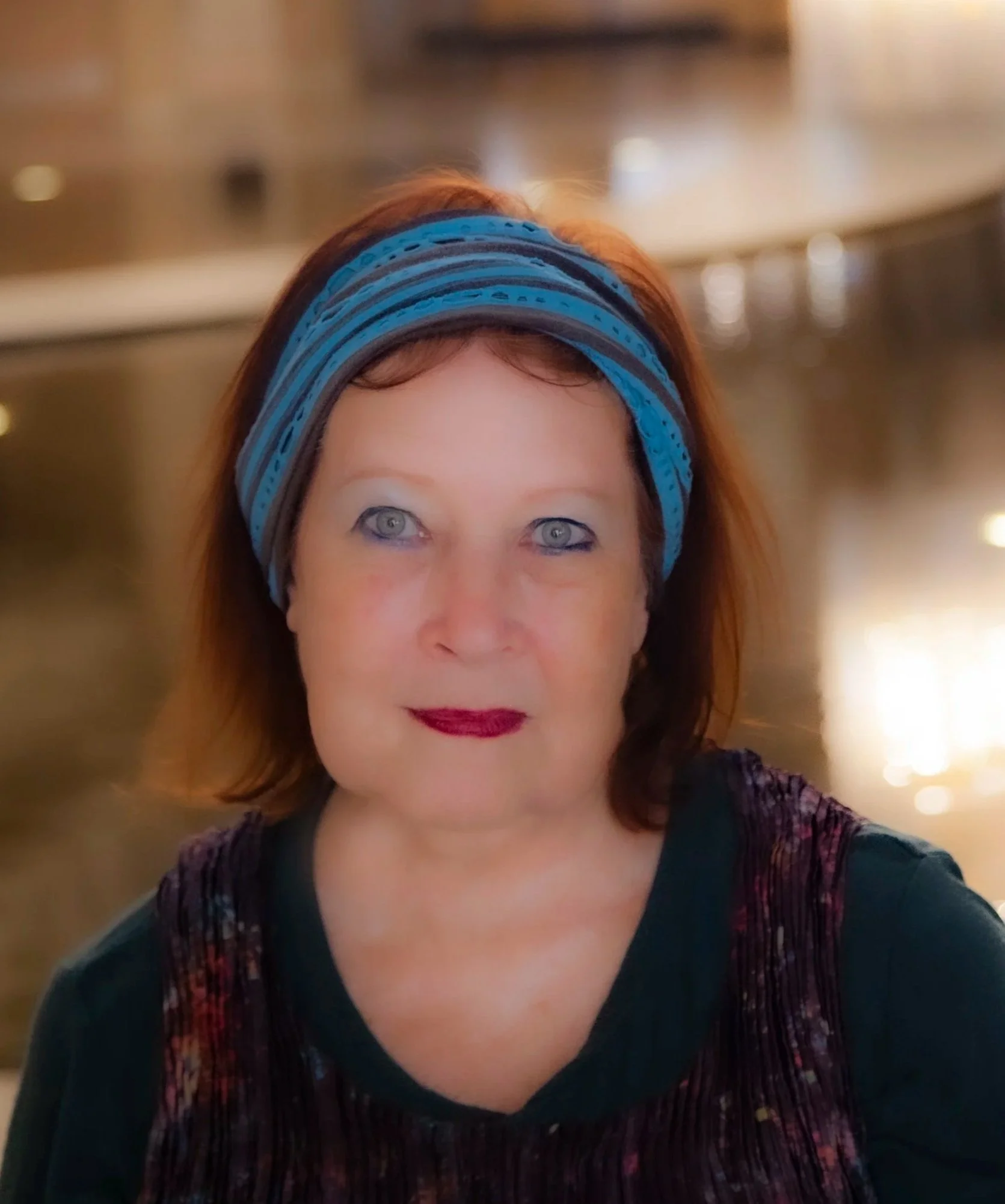
Jena Woodhouse
Image:
Anna Jacobson
About Jena
Jena Woodhouse spent her childhood on a farm in the Keppel Bay (Ganumi Bara) hinterland, on Queensland’s Capricorn Coast, before moving to Brisbane, where she attended the University of Queensland, graduating with first class Honours in Russian Language and Literature, a triple major in English, Australian, and Women’s literature, and a postgraduate Dip. Ed. She later completed a Master’s degree in Creative Writing at QUT. She also has a qualification in Librarianship.
Her occupations have included teaching Russian, and English as a Second Language (to immigrants and refugees), and working for ten years as a fiction and poetry editor for a university publishing house, before relocating to Greece. In Athens, she was recruited by the British Council as an examiner (for Cambridge University Certificates in English) and the Hellenic-American Union (for examinations in international certificates in English from the University of Michigan, US). She also worked for some years as a sub-editor and arts journalist with her own by-line for the Athens-based subsidiary of the International Herald Tribune.
She is also the poetry editor for Hecate.
Her personal writing and publishing span several decades, and she is the author/ translator/ co-compiler of thirteen book and chapbook publications, including eight poetry titles. Two of her books were reissued: Metis, the Octopus and the Olive Tree (1st ed. Jam Roll Press; 2nd ed. UQP) and the short fiction collection Dreams of Flight (Ginninderra).
Full details of individual publications and reviews are available on the AustLit database.
She has received awards for poetry, long and short fiction and writing for children, and her work has appeared in publications in Canada, the US, Ireland and Greece, as well as Australia. Her poems have been shortlisted three times for the Montreal International Poetry Prize, and five times for the ACU Poetry Prize (among numerous other honours and awards), and she has read her work, by invitation, in Germany, France and Greece, in addition to Australia.
Some of her poems have been set to music and recorded by internationally renowned, Queensland-born composer Betty Beath. Compositions include:
2018: Evie dances: a cycle of three songs for voice and piano. Music by Betty Beath, words by Jena Woodhouse.
1991: River songs for soprano voice and piano. Music by Betty Beath, words by Jena Woodhouse.
In recent years, she has been awarded creative residencies in Scotland (a Hawthornden Fellowship); France (a Tenot Foundation Bursary at CAMAC Centre d’Art, Marnay-sur-Seine); Ireland (on three occasions, at the Tyrone Guthrie Centre at Annaghmakerrig); Greece (an AAIA – Australian Archaeological Institute at Athens – Creative Residency; and embedded author status, on three occasions, at the British School at Knossos, Crete); besides residencies within Australia.
Abiding interests and influences include the natural world; the arts; mythology, especially that of Greece; Classical and Bronze-Age archaeology; travel, literature from various cultures, and modern European languages. She speaks Modern Greek and Russian, some French, and is currently attending Italian language classes.
A pivotal and auspicious period in her development as a poet was the decade she spent, from the early 1980s to the early 1990s, as a frequent weekend guest at Abydos, Val Vallis’s retreat at The Knoll on Tamborine Mountain. Thanks to Val’s generosity in lending the key to Abydos, she was able to find peace and inspiration in what was then the sylvan haven of the Mountain. Her poems inspired by that experience, published as Green Dance: Tamborine Mountain Poems, became the inaugural poetry publication of Calanthe Press in 2018.
Tamborine Mountain, a unique world within a world, has, she senses, been a place revered by poets and song-makers for thousands of years. It continues to nourish and replenish the springs of wonder and creativity. She would like to acknowledge those unknown singers who preceded her, and also Raymond Curtis, one of the Mountain’s own true poets, and all those whose love for the Mountain has moved them to celebrate it in poetry and song.
Jena Woodhouse has been identified as an author significant to Queensland.
Book and chapbook publications:
- His Battalion (a translation from the Russian of a novella of military fiction commissioned by UQP, 1981)
- Eros in Landscape (poetry, Jacaranda Press 1989)
- Passenger on a Ferry (poetry, UQP 1994)
- Metis, the Octopus and the Olive Tree (children’s novella, Jam Roll Press 2003, UQP 2004)
- Hidden Desires: Australian Women Writing (anthology, with Christina Houen) (Ginninderra 2006)
- Farming Ghosts (a novel, Ginninderra 2009)
- Dreams of Flight (short fiction, Ginninderra 2014)
- Green Dance: Tamborine Mountain Poems (Calanthe Press, 2018)
- The Book of Lost Addresses: a retrospective (poetry chapbook, Picaro Poets 2020)
- On the Windswept Bridge (poetry chapbook, Pocket Poets 2020)
- News from the Village: Travels in Rural Greece (poetry chapbook, Picaro Poets 2021).
- Bitter Oranges: a Memoir of Athens (Picaro Poets Series, 2023).
- The Singing Ship: A Study in Resistances (Calanthe Press, 2026).
Quotes from reviews:
“Woodhouse has that rare ability to discern elements of the epic in the ordinary.”
Simon Patton, Australian Book Review
“Woodhouse values learning, the past, other cultures, but is also acutely aware of simplicities and their multiple potentialities, of life as a thread which, although tenuous, is continuously being spun.”
Gillian Bouras, The Southeastern Review (Athens)
“Jena Woodhouse is best known to Australian readers as a poet and her fiction is written in a poet’s prose, dense with imagery and unexpected turns of language and thought.”
Kerryn Goldsworthy, Sydney Morning Herald
“Woodhouse’s approach to nature poetry is complex, at once unapologetically anthropomorphic and firmly ecological. …Woodhouse is an accomplished poet with many publications and awards to her name. She is also a lyricist and an author of prose, including children’s fiction. These layers of her identity are evident in this vital and vivacious poetry, which is as alive with promise as the soil after rain.”
Alison Clifton, StylusLit
“Sober and sure of foot at its best, this poetry goes to the heart of its matter in my native landscapes of place and mind to tap roots there that I should love to have tapped myself.”
Dimitris Tsaloumas, poet (on back cover of poetry collection, Passenger on a Ferry)